
Product Category
Lux Calibration System
High-Precision Optical Benches and Standard Reference Light Sources for Illuminance and Photometer Verification
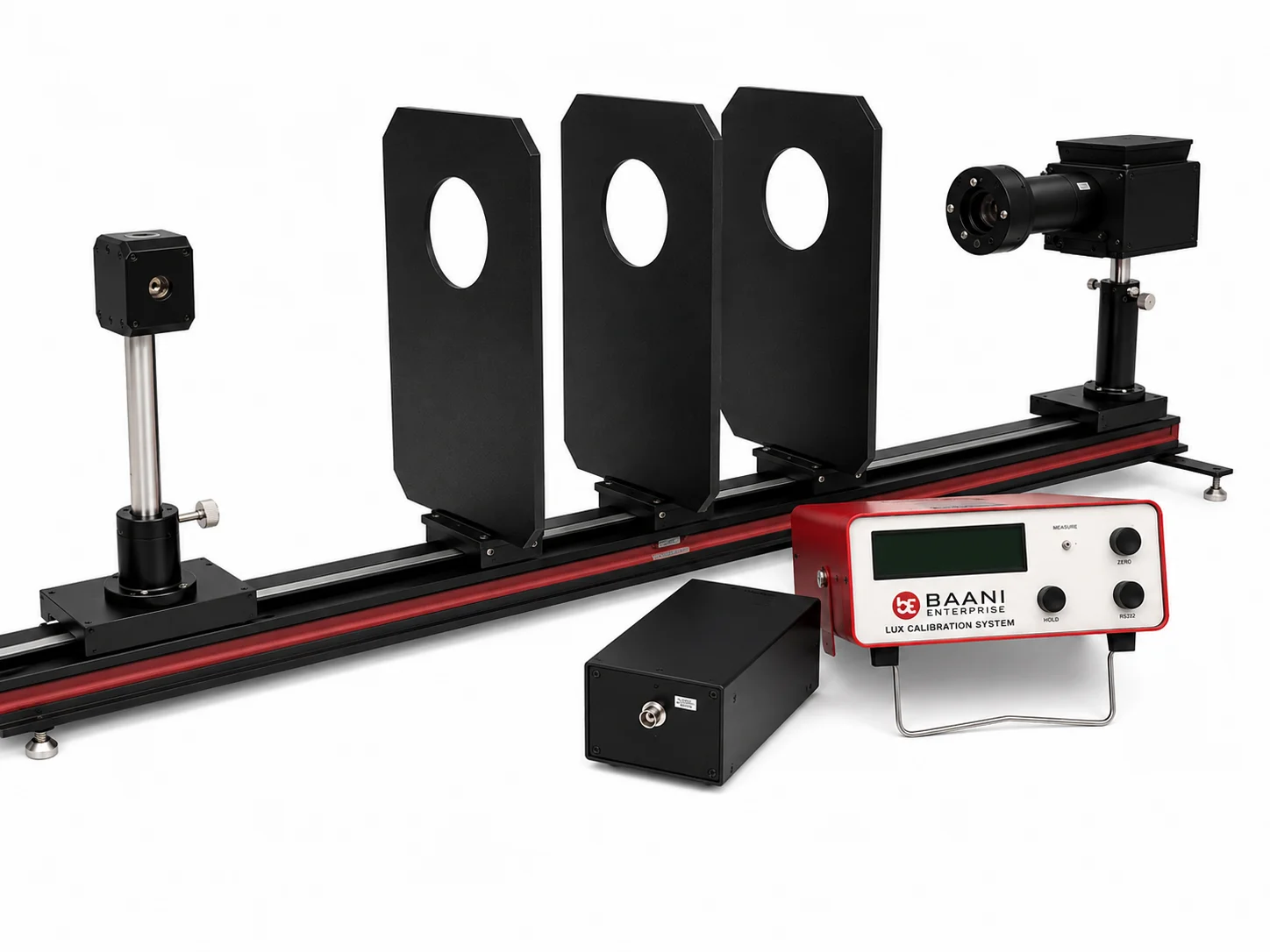
Baani Enterprise designs and manufactures high-performance Lux Calibration Systems engineered to establish absolute accuracy in photometry and illuminance measurement. Engineered for calibration laboratories, manufacturing QA facilities, and research institutes, our systems provide a highly controlled, stray-light-shielded environment for validating lux meters and photodiode sensors.
__⋅ __
Configurations
0 TO 20000 LUX__
Capacity Range
__
Output
__
Overall Accuracy Class
NABL / NPL Traceable
Traceability
Accepted — Contact Us
Custom Orders
Features
01
Precision Photometric Bench Structure
Features a rigid, twist-resistant aluminum structural rail system coated in ultra-matte, non-reflective optical black paint to eliminate scatter and secondary reflections.
02
Integrated Universal Sensor Fixturing
Features a self-centering, multi-axis clamping jig that aligns the optical center of various lux meter detector heads with the lamp filament axis.
03
Multi-Stage Stray Light Optical Baffles
Incorporates strategically placed, sharp-edged internal light-blocking diaphragms along the bench length to intercept off-axis light rays before they hit the testing sensor.
04
Laser-Guided Coaxial Alignment Tool
Includes a detachable red alignment laser module to verify that the lamp filament, baffles, and sensor face match a perfectly straight horizontal line.
About the Category
What is a Lux Calibration System ?
A Lux Calibration System (also known as an illuminance calibration bench or photometer calibration system) is a highly specialized radiometric and photometric testing apparatus. It is used to test, calibrate, and verify the accuracy of lux meters, illuminance sensors, photometers, and light logging equipment. Precise light measurement is essential across industries like consumer electronics, automotive lighting, aerospace instrument panels, and occupational health safety. Over time, environmental exposure, sensor aging, and UV degradation can cause severe measurement drift in silicon photodiodes, making traceable optical recalibration critical.
Working Principle
The fundamental operation of a lux calibration platform relies on the Inverse-Square Law of Illuminance, where the illuminance (E) hitting a sensor surface is directly proportional to the luminous intensity (I) of the standard lamp source and inversely proportional to the square of the distance (d) from the source filament. The system consists of a precision photometric bench with a light-tight housing, a stabilized Standard Luminous Intensity Lamp (typically a tungsten-halogen source configured to CIE Standard Illuminant A at a color temperature of 2856K, and an automated linear positioning trolley.
The system controls the lamp with an ultra-stable, programmable DC constant current power supply. As the automated trolley moves the unit under test (UUT) along the optical axis, its exact distance from the lamp filament is tracked. High-resolution sensors convert the received light into an electrical current or digital lux value, which the software then processes and cross-references against calculated mathematical values to isolate linearity, spectral response, and cosine correction deviations.
Why Industries Use It
Industrial sectors deploy these robust photometric systems to replace unsafe, ambient comparison methods. Calibrating an optical sensor in an open room introduces measurement errors from secondary reflections, room ambient stray light, and unstable light source frequencies. A dedicated, baffled black-body darkroom bench isolates the testing environment, ensuring the reference sensor receives pure, non-reflected, unmodulated light for highly reproducible calibration cycles.
Importance in Calibration & Metrology
In accredited calibration laboratories and metrology facilities, lux calibration benches establish the physical tracking link back to national primary candela standards. To maintain a low calibration and measurement capability (CMC) uncertainty profile, the system must control thermal dissipation, eliminate spatial alignment errors, and precisely monitor lamp operating times. Adhering to these design practices ensures absolute compliance with international standards such as ISO/IEC 17025, CIE Publication 69, and DIN 5032, providing a clear path for legal and commercial data validation.
Why choose Lux Calibration System from Baani Enterprise
Manufactured in Delhi. Verified Against National Standards.
The Lux Calibration System manufactured by Baani Enterprise is produced at our in-house Delhi facility and calibrated against standards traceable to NABL-accredited and NPL-referenced laboratories — the same traceability chain demanded by India’s leading research and industrial institutions.
We have supplied Lux Calibration System to clients including CSIR-NPL, VIPL Bangalore, Roots Industries, and SITRA since 1998.
01
Traceable Calibration Standards
All instruments manufactured and verified against national standards, ensuring full measurement traceability required for ISO-compliant quality systems.
02
In-House Manufacturing in Delhi
Complete control over production from our Delhi facility — enabling faster turnaround, custom specifications, and direct after-sales support.
03
Proven Institutional Track Record
Supplied to CSIR-NPL, VIPL Bangalore, Roots Industries, and SITRA — credibility built over 25+ years of reliable, precise delivery.
04
Expanding Global Supply
Actively expanding supply capabilities to serve international clients including laboratories and testing facilities in the UAE and Gulf region.
Need a Lux Calibration System for your facility ?
Contact us to discuss capacity, accuracy class, traceability, and delivery. Custom specifications welcome.