
Product Category
Force Calibration Machine
Metrology-Grade Reference Standards and Automated Hydraulic Systems for Advanced Transducer Verification
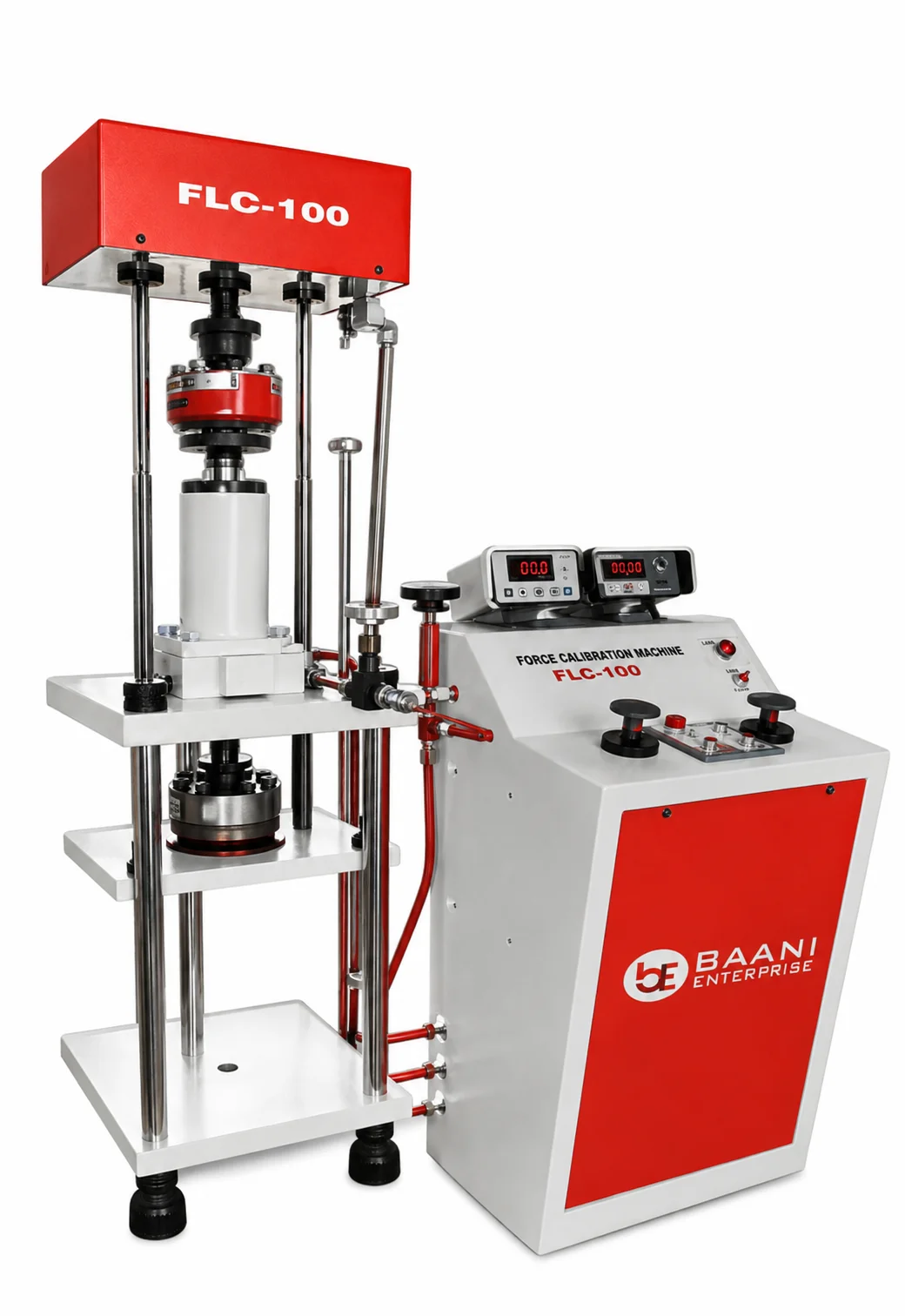
Baani Enterprise engineers next-generation Force Calibration Machines built to deliver precise, repeatable tension and compression load application. Developed specifically for NABL-accredited laboratories, aerospace testing stands, and heavy industrial manufacturers, our machines ensure absolute compliance with global force measurement criteria.
__⋅ __
Configurations
50 – 3000 kN
Capacity Range
OPERATING RANGE 5% TO 100% OF MACHINE CAPICITY
Output
CLASS 1 & CLASS 2 AS PER ISO 376/ IS 4169 STANDARD
Overall Accuracy Class
NABL / NPL Traceable
Traceability
Accepted — Contact Us
Custom Orders
Features
01
Dual-Directional Compression & Tension Calibration Frame
Engineered with an open gantry framework that allows seamless, high-accuracy force application across both tension and compression test configurations without requiring complex structural re-fixturing.
02
Advanced PID Closed-Loop Actuation Control
Utilizes high-response digital servo valves or precision servo-motor mechanics to dynamically control load application speeds and lock forces onto target values with zero hunting.
03
High-Rigidity, Low-Deflection Column Architecture
Constructed with structural tie-bar columns optimized via Finite Element Analysis (FEA) to eliminate axial flexure and minimize lateral parasitic bending forces.x
04
Precision Linear Crosshead Alignment Bearings
Equipped with heavy-duty low-friction guide rods that maintain absolute concentricity and coaxial line alignment during extreme structural load cycles.
About the Category
What is a Force Calibration Machine?
A Force Calibration Machine (FCM) is an essential primary or secondary mechanical standard framework engineered to verify, test, and calibrate force-measuring instruments, such as precision load cells, proving rings, and force transducers. Within modern heavy engineering, manufacturing, and structural defense, accurate load verification is fundamental to operational safety and system reliability. Because mechanical instrumentation degrades under sustained cycle fatigue, environmental shifts, and physical overloading, specialized calibration machinery is required to establish a continuous baseline of accuracy.
Working Principle
The fundamental operation of a Force Calibration Machine relies on the controlled mechanical application of an axial linear load against a unit under test (UUT) positioned in series with a highly accurate reference standard. Depending on the design capacity, the driving mechanism uses either an automated servo-motor mechanical ball screw or an advanced closed-loop hydraulic cylinder actuator. The indicator system feeds continuous excitation voltages to both the integrated master reference standard sensor and the customer’s transducer. As structural forces are gradually introduced, advanced proportional-integral-derivative (PID) control loops regulate the system to maintain exact load thresholds, while high-speed data streams convert the microvolt changes (mV/V) into digital force values (kN, kgf, or lbf) for immediate data analysis.
Why Industries Use It
Industrial sectors deploy these robust calibration systems to prevent critical load reading failures and structural safety audit breaches. Relying on makeshift hydraulic presses or unverified universal testing machines introduces bending moments, friction losses, and lateral side loads that alter the calibrated accuracy of a sensor. A dedicated force calibration frame uses precise linear guiding bearings to keep forces entirely axial, eliminating parasitic variables and providing clean, high-integrity measurement values.
Importance in Metrology & Standards Compliance
In accredited calibration labs and international metrology institutes, force calibration benches form the core of mechanical traceability frameworks. To calculate reliable measurement uncertainty profiles, a machine must exhibit strict structural rigidity, minimal thermal expansion coefficients, and ultra-high alignment precision. Maintaining these tightly controlled operating states ensures compliance with mandatory industry standards such as ISO 376 (for force-proving instruments) and ASTM E74. This strict compliance guarantees that physical material limits, quality control procedures, and component certifications match verified global engineering metrics.
Why choose Force Calibration Machine from Baani Enterprise
Manufactured in Delhi. Verified Against National Standards.
The Force Calibration Machine manufactured by Baani Enterprise is produced at our in-house Delhi facility and calibrated against standards traceable to NABL-accredited and NPL-referenced laboratories — the same traceability chain demanded by India’s leading research and industrial institutions.
We have supplied Force Calibration Machine to clients including CSIR-NPL, VIPL Bangalore, Roots Industries, and SITRA since 1998.
01
Traceable Calibration Standards
All instruments manufactured and verified against national standards, ensuring full measurement traceability required for ISO-compliant quality systems.
02
In-House Manufacturing in Delhi
Complete control over production from our Delhi facility — enabling faster turnaround, custom specifications, and direct after-sales support.
03
Proven Institutional Track Record
Supplied to CSIR-NPL, VIPL Bangalore, Roots Industries, and SITRA — credibility built over 25+ years of reliable, precise delivery.
04
Expanding Global Supply
Actively expanding supply capabilities to serve international clients including laboratories and testing facilities in the UAE and Gulf region.
Need a Force Calibration Machine for your facility ?
Contact us to discuss capacity, accuracy class, traceability, and delivery. Custom specifications welcome.