
Product Category
Shore Hardness Machine
Precision Durometer Stands and Automated Hardness Systems for Elastomers, Plastics, and Non-Rigid Polymers.
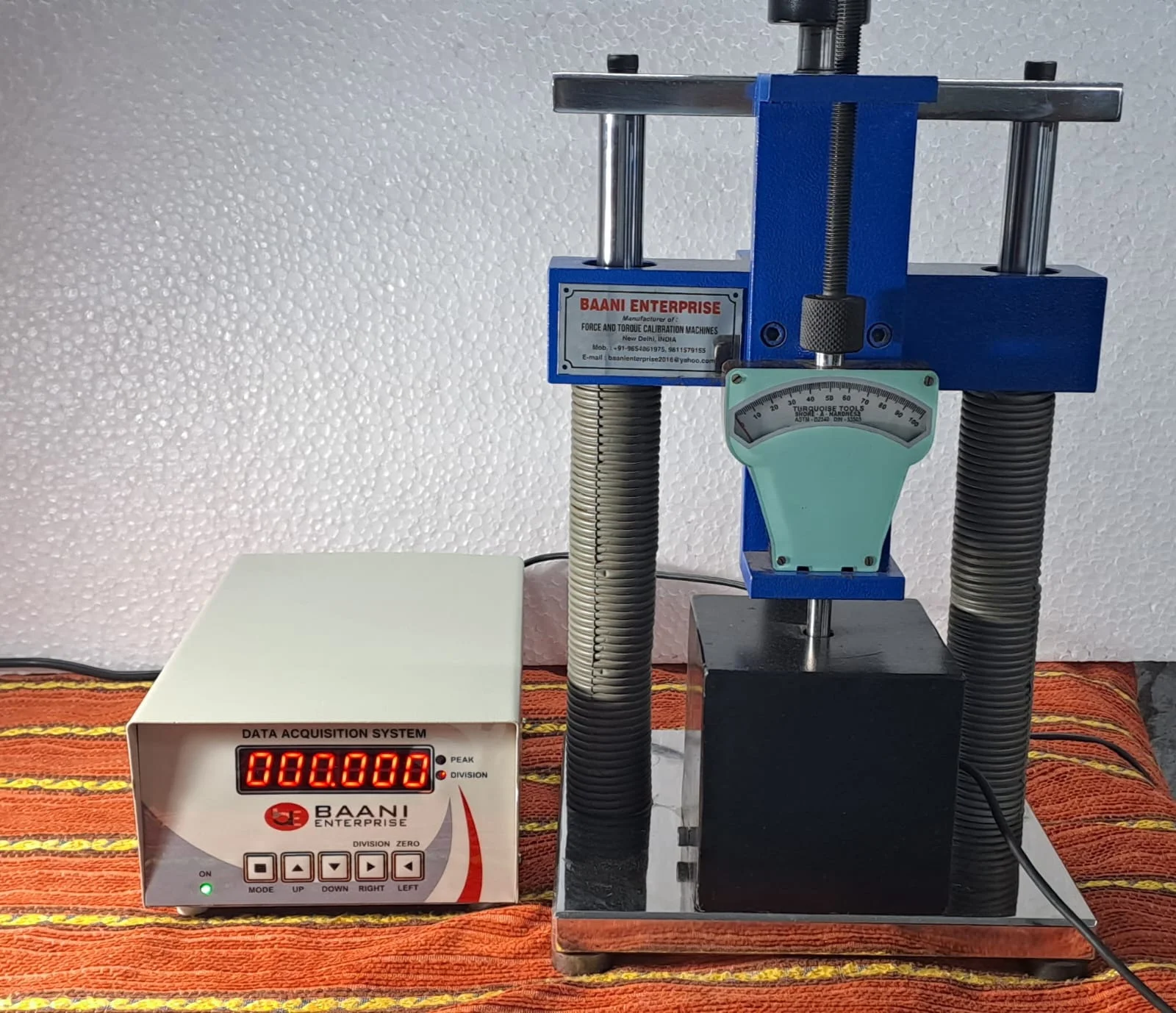
Baani Enterprise manufactures premier Shore Hardness Testing Machines engineered to deliver highly repeatable, operator-independent durometer measurements. Designed to eliminate manual perpendicularity and application force variations, our systems ensure absolute measurement integrity across all elastomer manufacturing and polymer testing laboratories.
__⋅ __
Configurations
__
Capacity Range
__
Output
__
Overall Accuracy Class
NABL / NMI Traceable
Traceability
Accepted — Contact Us
Custom Orders
Features
01
Direct Primary Force Generation
Applies true physical deadweight masses directly to the sensor under test, entirely eliminating intermediate transfer devices or load-cell loop drift errors.
02
Advanced Automation & PLC Control
Fully automated mass selection, loading, and unloading sequences governed by industrial PLC architectures to guarantee safe, smooth, and shock-free load transitions.
03
Dual-Directional Calibration Capability
Precision-engineered frame design permits seamless, highly accurate force application in both tension and compression regimes without needing to re-fixture the device.
04
Comprehensive Environmental Compensation Integration
Software integration interfaces seamlessly with lab environment data to dynamically track air buoyancy and ambient fluctuations, ensuring real-time mathematical validation.
About the Category
What is a Shore Hardness Machine ?
A Shore Hardness Machine (commonly referred to as a durometer testing system) is an essential material metrology instrument designed to determine the indentation hardness of non-rigid, elastic, and semi-rigid materials. These systems primarily evaluate elastomers, vulcanized rubbers, thermoplastic polymers, gels, resins, and hard plastics. Because the mechanical performance and environmental durability of a polymer are linked to its molecular cross-linking density, verifying physical hardness is critical during polymer blending, curing, and component manufacturing to prevent material performance failures.
Working Principle
The physical mechanics of a Shore hardness test rely on measuring the depth of an indentation caused by a precisely shaped geometry forced into a material specimen. A durometer sensor features a calibrated indentor—typically a hardened steel truncated cone for softer scales (Shore A) or a sharp 30 degree conical point for harder compounds (Shore D)—protruding from the flat base plate of the gauge.
The Shore Hardness Machine houses this durometer assembly within a rigid vertical guide track. When actuated, a calibrated reference deadweight or an automated electronic actuator lowers the durometer base plate onto the material surface under a specified constant static force (10N for Shore A, 50N for Shore D). An internal calibrated spring system counters the material’s resistance, and the linear displacement of the indentor pin is translated into digital or analog Shore units, spanning a scale from 0 (maximum indentation depth of 2.5 mm) to 100 (zero indentation depth).
Why Industries Use It
Industrial sectors deploy structural durometer stands to eliminate human testing errors. Handheld durometer testing introduces operator variables, such as uneven application velocity, off-axis angular tilt, and inconsistent force application. A dedicated Shore Hardness Machine provides a stable mechanical environment, securing the specimen flatly against an anvil and lowering the sensor along a perfectly perpendicular linear path.
Importance in Metrology & Standards Compliance
In accredited material testing laboratories and R&D facilities, Shore hardness values serve as a standard metric for quality control and material classification. Because polymers experience structural relaxation and viscoelastic creep during testing, the indentation depth changes over time. To achieve low measurement uncertainty, modern durometer machines feature integrated electronic timers that log the hardness value at precise intervals (such as exactly 1 seconds or 3 seconds after initial contact), fully complying with strict standards like ISO 48-4, ASTM D2240, and DIN 53505.
Why choose Shore Hardness Machine from Baani Enterprise
Manufactured in Delhi. Verified Against National Standards.
The Shore Hardness Machine manufactured by Baani Enterprise is produced at our in-house Delhi facility and calibrated against standards traceable to NABL-accredited and NPL-referenced laboratories — the same traceability chain demanded by India’s leading research and industrial institutions.
We have supplied Shore Hardness Machine to clients including CSIR-NPL, VIPL Bangalore, Roots Industries, and SITRA since 1998.
01
Traceable Calibration Standards
All instruments manufactured and verified against national standards, ensuring full measurement traceability required for ISO-compliant quality systems.
02
In-House Manufacturing in Delhi
Complete control over production from our Delhi facility — enabling faster turnaround, custom specifications, and direct after-sales support.
03
Proven Institutional Track Record
Supplied to CSIR-NPL, VIPL Bangalore, Roots Industries, and SITRA — credibility built over 25+ years of reliable, precise delivery.
04
Expanding Global Supply
Actively expanding supply capabilities to serve international clients including laboratories and testing facilities in the UAE and Gulf region.
Need a Shore Hardness Machine for your facility ?
Contact us to discuss capacity, accuracy class, traceability, and delivery. Custom specifications welcome.