
Product Category
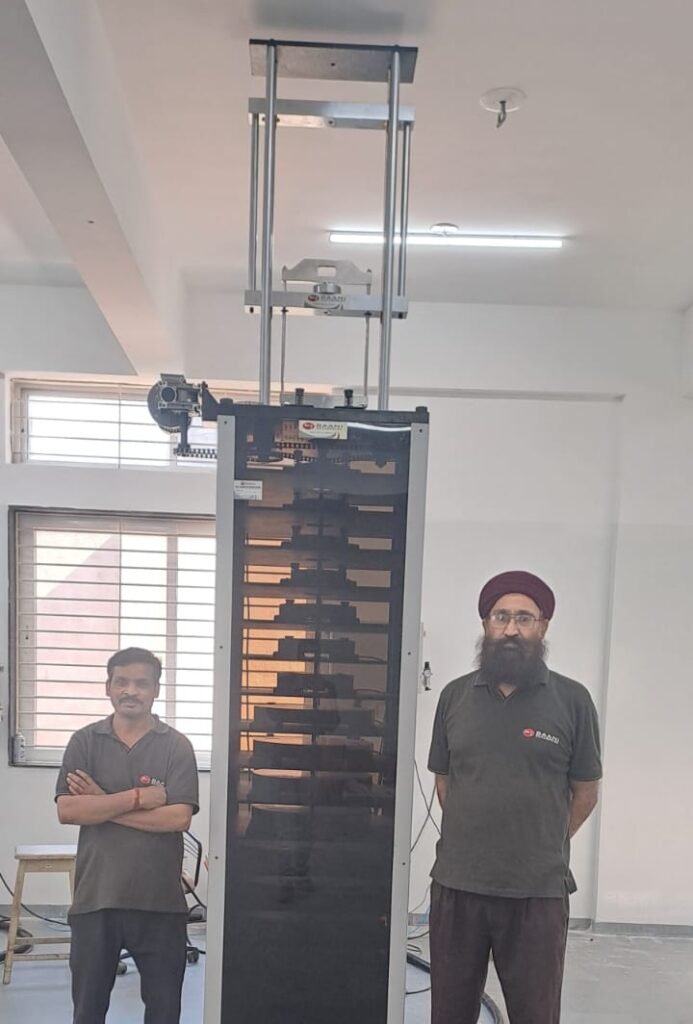
Deadweight Force Standard Machine
Ultimate Primary Standards for High-Precision Force Calibration and Transducer Verification
Baani Enterprise engineers premier Deadweight Force Standard Machines engineered to serve as the baseline for force measurement across laboratories and heavy industrial complexes. By applying true physical masses directly under local gravitational force, our systems achieve the lowest possible measurement uncertainty for verifying reference load cells and proving instruments.
Automatic weight loading ⋅ Vertical (Tension/Compression)
Configurations
0.1 – 200 kN
Capacity Range
1-4 mV/V Standard
Output
Better than ± 0.0195% of applied load
Overall Accuracy Class
NABL / NPL Traceable
Traceability
Accepted — Contact Us
Custom Orders
Features
01
Direct Primary Force Generation
Applies true physical deadweight masses directly to the sensor under test, entirely eliminating intermediate transfer devices or load-cell loop drift errors.
02
Advanced Automation & PLC Control
Fully automated mass selection, loading, and unloading sequences governed by industrial PLC architectures to guarantee safe, smooth, and shock-free load transitions.
03
Dual-Directional Calibration Capability
Precision-engineered frame design permits seamless, highly accurate force application in both tension and compression regimes without needing to re-fixture the device.
04
Comprehensive Environmental Compensation Integration
Software integration interfaces seamlessly with lab environment data to dynamically track air buoyancy and ambient fluctuations, ensuring real-time mathematical validation.
About the Category
What is a Deadweight Force Standard Machine ?
A Deadweight Force Standard Machine (DWM) represents the pinnacle of primary force standards in mechanical metrology. Unlike secondary or transfer standards that rely on reference load cells or hydraulic amplification to estimate force, a deadweight machine determines force directly from primary physical quantities: mass, local gravitational acceleration, and air buoyancy. It is designed to generate highly accurate and stable forces in both tension and compression modes to calibrate high-precision transducers, reference force transfer standards, and load cells.
Working Principle
The fundamental operation of a Deadweight Force Standard Machine is governed by Newton’s Second Law of Motion (F=m⋅g), adjusted for environmental factors. A precisely machined and calibrated set of stainless steel masses is suspended or supported within a rigid mechanical frame. When a specific force is selected via the automation interface, a mechanical lift mechanisms applies or removes the required combination of masses onto a central loading spindle. The force exerted on the unit under test (UUT) is calculated using the absolute mass values corrected for local gravity at the specific geographic coordinates of installation, alongside a correction factor for air buoyancy derived from ambient air density.
Why Industries Rely on Premium Indicators
Modern manufacturing, structural testing, and safety-critical engineering demand absolute measurement certainty. Secondary calibration methods introduce cumulative errors due to instrument drift, thermal coefficients, and electronic noise. High-end calibration facilities use primary deadweight machines because they deliver the lowest possible expanded measurement uncertainty (typically better than $\pm 0.002\%$ to $\pm 0.005\%$). This flawless stability provides the unshakeable accuracy baseline required to verify high-capacity reference load cells used throughout primary supply chains.
Importance in Calibration & Metrology
Within national metrology institutes (NMIs) and accredited laboratories, deadweight force standard machines form the foundation of the force measurement traceability pyramid. Instruments calibrated on these machines—such as torque sensors, transfer standards, and secondary load cells—are subsequently deployed to calibrate industrial testing equipment like Universal Testing Machines (UTMs). Maintaining this absolute primary accuracy guarantees that material yield strengths, structural integrity limits, and component tolerances are standardized and legally verifiable.
Why choose Deadweight Force Standard Machine from Baani Enterprise
Manufactured in Delhi. Verified Against National Standards.
The Deadweight Force Standard Machines manufactured by Baani Enterprise is produced at our in-house Delhi facility and calibrated against standards traceable to NABL-accredited and NPL-referenced laboratories — the same traceability chain demanded by India’s leading research and industrial institutions.
We have supplied Deadweight Force Standard Machines to clients including CSIR-NPL, VIPL Bangalore, Roots Industries, and SITRA since 1998.
01
Traceable Calibration Standards
All instruments manufactured and verified against national standards, ensuring full measurement traceability required for ISO-compliant quality systems.
02
In-House Manufacturing in Delhi
Complete control over production from our Delhi facility — enabling faster turnaround, custom specifications, and direct after-sales support.
03
Proven Institutional Track Record
Supplied to CSIR-NPL, VIPL Bangalore, Roots Industries, and SITRA — credibility built over 25+ years of reliable, precise delivery.
04
Expanding Global Supply
Actively expanding supply capabilities to serve international clients including laboratories and testing facilities in the UAE and Gulf region.
Need a Deadweight Force Standard Machine for your facility ?
Contact us to discuss capacity, accuracy class, traceability, and delivery. Custom specifications welcome.